Building on the experience and success of a model urban climate change mitigation and adaptation education centre implemented in Warsaw’s Wawer district, we are embarking on constructing another climate-friendly school.
In January 2026, we launched a three-year project to build the resilience of School Complex No. 3 in Wołomin to the challenges of climate change and water resource protection, while deepening students’ and teachers’ understanding of climate change impacts and adaptation methods.
In partnership with the Wołomin Commune, we will create an education centre accessible to all Wołomin residents and other interested parties.

What do we intend to achieve?
The community of School Complex No. 3 in Wołomin is grappling with the severe effects of climate change. The school building is subject to cyclical flooding during heavy rains, while during periods of high temperatures, the classrooms and terrace overheat, making lessons impossible. Additional challenges include a lack of shade and low biodiversity in the school’s surroundings.
The project aims to build the resilience of the School Complex to the aforementioned challenges related to climate change and to protect water resources. This will be achieved through the implementation of a comprehensive blue-green infrastructure system, which will manage all rainwater from the roofs of the School Complex. Additionally, our goal is to implement solutions increasing biodiversity. Microhabitats and shading vegetation will be created on the school grounds, improving the microclimate. The implementation of this project will address the problems of flooding, building overheating, and low biodiversity.
Furthermore, we will conduct educational and informational activities to increase students’ and teachers’ knowledge about climate change, its effects, and effective adaptation measures. The dissemination of nature-based solutions will contribute to the ability to implement the recommended solutions, making them easily replicable. This will allow for their widespread use in other educational institutions and by residents throughout Wołomin.
Who is this project for?
Primarily, we will work with the school community of the School Complex No. 3 in Wołomin, including students, teaching staff, and other school employees.
Additionally, the project will extend to students from other Wołomin schools participating in the municipal Green Classes program, who will participate in the maintenance workshops, as well as to families of students from Primary School and other Wołomin residents. All public activities, such as the picnic and educational trail, brochures, and informational activities, will be directed to them.
The project is also aimed at teachers and administrators of other schools in Wołomin and throughout Poland. They will benefit from an educational trail and training program that will allow them to develop their skills in conducting climate education.
What will happen as part of the project?
We will create a demonstration area at the school, along with an educational trail on mitigating and adapting to the effects of climate change. All work will be carried out in a participatory manner, with the participation of the entire school community, which we will prepare for the project.
The area around School Complex will provide an excellent educational base not only for students from the schools (primary and secondary), but also for students and teachers from other schools. Therefore, teachers and school administrators from across the country interested in the topic will be able to take advantage of the free training program. All activities will be completed in December 2028.
Introduction of the School Community at School Complex No. 3 to the Project
We launched the project with a series of activities aimed at familiarising the school community with the planned activities and introducing them to the project’s theme – issues related to adapting to climate change, using nature-based solutions.
We have completed an introductory training session with teachers and staff, which took place on March 23, 2026, and prepared teachers to conduct informational lessons about the project. During the sessions, class teachers will familiarise students with the events planned for the project and discuss the challenges of climate change and the role of blue-green infrastructure in adapting cities to its negative impacts.
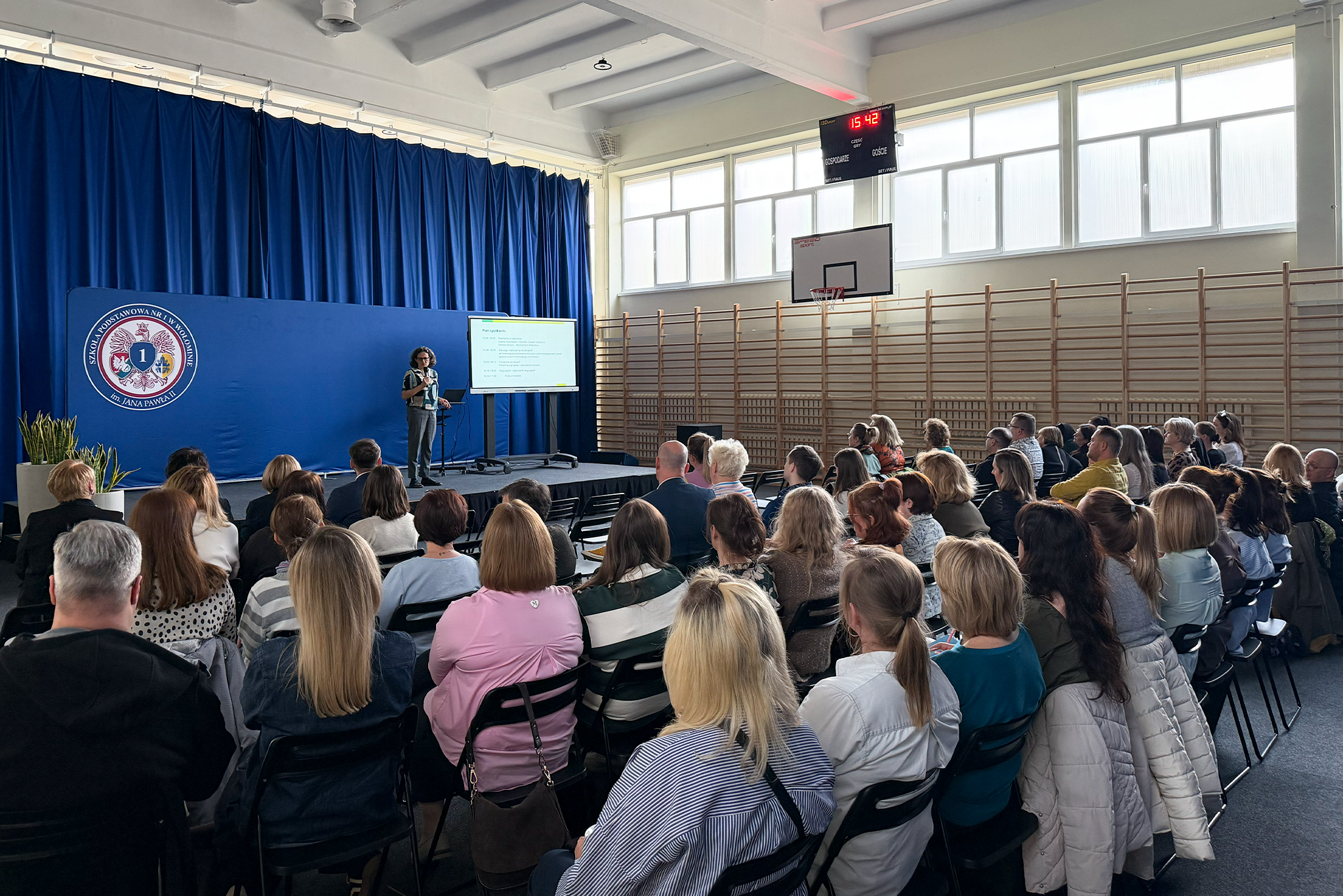
Introductory meeting for teachers, March 23, 2026, School Complex in Wołomin, photo: Anna Kacprzak, Wołomin City Hall
Following the teacher training, we selected volunteer teachers and students to become school project ambassadors. We organised a two-hour workshop for the ambassadors, during which we developed a joint action plan. The school ambassadors will be supporting the consultation, education, and promotion of the project among the school community, which will translate into greater community engagement in the project.
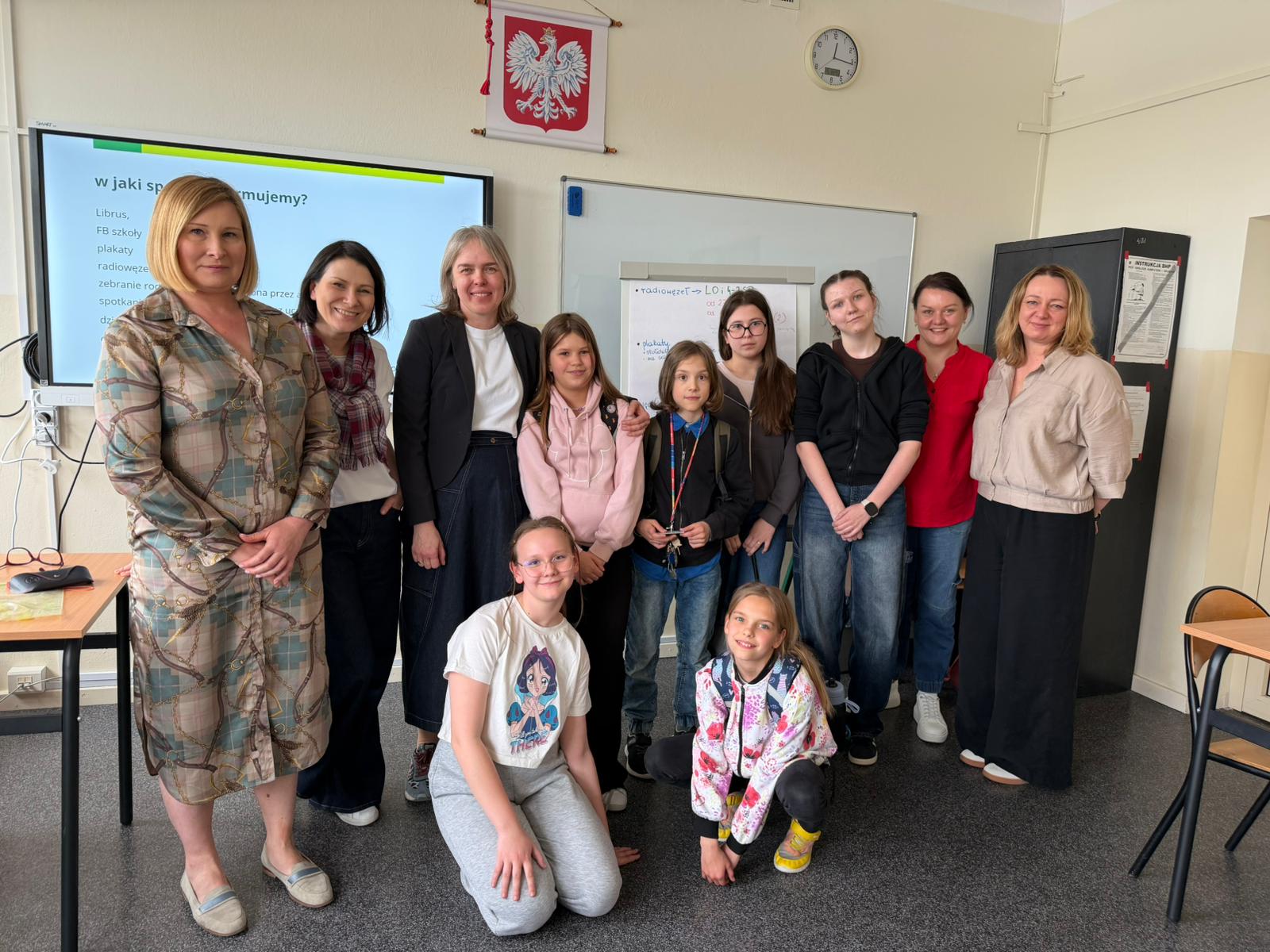
Ilona Gosk and Barbara Surmacz-Dobrowolska from the Sendzimir Foundation, who are implementing the project, along with the team of school project ambassadors. Photo: Anna Kacprzak, Wołomin Municipal Office
Consultations with the entire school community
Students and teachers will participate in workshops to design a selected section of the school grounds. We will work with them to refine the investment (implementation) design so that it not only addresses the needs related to climate change but also best meets the expectations of the school community.
The concepts resulting from the workshops, after being developed by the designer, will be submitted for consultation. This will allow us to gather feedback and comments on the designs and address the expectations of all site users.
Preparation of the detailed design and implementation of the blue-green infrastructure around the school
We will use the results of the workshops and consultation process to prepare the detailed design for the entire project. We will implement the nature-based solutions in collaboration with the Wołomin Municipality and the school community.
At the School Complex, we will implement innovative, nature-based solutions that incorporate best practices for building climate resilience in stormwater management and enhance the area’s biodiversity. This will mitigate the heat island effect on the school terrace and the building’s heat buildup, and utilise all water from the rooftops. These will include:
- various types of rain gardens,
- a retention basin such as a variable-moisture flower meadow,
- water retention benches,
- a rainwater tank,
- permeable surfaces to increase land retention,
- a green wall,
- green pergolas for shade,
- a terrace with a natural surface,
- plantings of tall trees and perennials near the building,
- multi-story plantings with groundcover, understory, and trees,
- a composting area to support soil-forming processes,
- microhabitats for various groups of organisms,
- a microforest created according to Miyawaki principles.
We will complement these solutions with small-scale architecture and natural play elements encouraging people to spend time outdoors, surrounded by nature: tunnels and a wicker hut, a sensory path, and natural sculptures.
We will complete all the projects with students and teachers at the beginning of the 2027/2028 school year. Students will be able to learn about the various stages of the nature-based solutions construction process, as well as how to care for the plants and the new facilities in the coming years.
Educational Trail and Instructional Brochures
According to the project’s objectives, the area around the school will be used for climate education even after the project is completed. To this end, we will create an educational trail, with the most interesting features marked with educational signs. The trail will include information about each facility or zone, as well as a QR code linking to online materials.
All users will be able to learn how each NBS operates and what it’s used for, and receive detailed instructions on how to implement similar solutions themselves.
We will also develop five educational brochures on solutions that support biodiversity, including: urban microforests, a drought-tolerant biocenotic garden, microhabitats for fauna and flora in the garden, microecosystems supporting biodiversity and retention for implementation on balconies or terraces, and planting a garden in moist and shaded areas.
Each brochure will describe specific nature-based solutions, present their benefits, and explain how to implement them in other locations. The brochures complement the Sendzimir Foundation’s educational materials and will be available in the Publications section of our website.
Educational Picnic and Outreach Activities
We will promote the solutions presented on the trail among Wołomin residents during an educational picnic inaugurating the climate-friendly school playground. The program will include a variety of educational activities, workshops, games with prizes, and performances, as well as guided walks around the project site.
All informational activities we will implement as part of the project are aimed at raising public awareness (especially among students, teachers, and other Wołomin residents) about possible actions contributing to adaptation to the effects of climate change using nature-based solutions.
After the project’s implementation, the grounds of the School Complex No. 3 in Wołomin will provide an excellent educational base for both students and teachers. It can be used for school trips and green lessons on adaptation to climate change for everyone who wants to visit a climate-friendly yard.
By creating an educational path at school and online, the implemented blue-green infrastructure can be used to conduct educational activities and inspire other schools to implement similar projects to increase retention and biodiversity.
Teacher training program (May-October 2028)
At the end of the project, we will conduct a two-stage training program for teachers and school managers from all over Poland, regarding education about adaptation to climate change in cities. The program will disseminate the possibility of using a demonstration school and increase the skills of conducting educational activities using nature-based solutions. It will consist of a month-long e-learning course and two different stationary workshops (a one-day workshop for teachers and managers from Wołomin and a two-day workshop for teachers from all over Poland).
Project value: PLN 4,305,139.06
Co-financing from European Funds: PLN 3,388,574.95
Implementation period: from January 1, 2026, to December 31, 2028.
Header photo: Tomasz Kaczor.